Helping coral restoration find the partners it needs to scale
The Challenge
The deputy director of the G20 Coral Research and Development Accelerator Platform (CORDAP) had a clear mission: restore the world's coral reefs. CORDAP was making progress and funding several projects, but wanted to do more.
The projects in flight were small-scale, and overly indexed on foundational academic research. The deputy director wanted to create greater impact across the short and long-term by harnessing industry, partnering with companies already working at a large scale on relevant technologies. But the few industry partners that did apply for funding often dropped out due to unclear business cases, or perceived risks such as Intellectual Property (IP) concerns.
The challenge was practical: systematically scanning the landscape of potential partners would take time and expertise his team simply did not have. Without a clear picture of who was working on which technologies, or what those organisations might need to engage with CORDAP, the scientific advisory board found it difficult to build programmes that would attract them.
The goal was to give CORDAP full visibility into the relevant industry ecosystem, and use that insight to help them build industry-science partnerships that could accelerate reef restoration.
The Solution
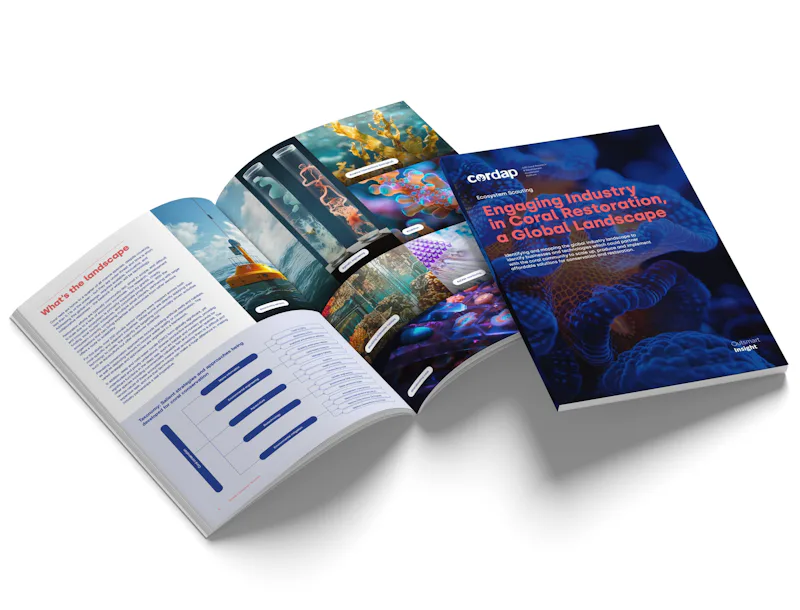
Outsmart began by building a taxonomy of five technology areas relevant to coral restoration: marine informatics, environmental engineering, aquaculture, biotechnology and environmental mitigation. By focusing the taxonomy on technology solutions rather than industry verticals, the companies identified were more likely to be relevant, and the chance of missing companies reduced.
Outsmart then assembled a team of 45 domain experts drawn from our network of over 8,500 active researchers and practitioners. These were scientists and technologists who already understood the relevant fields and could assess companies on technical merit rather than marketing claims. The team worked through 200 potential partner companies, evaluating each for technology credibility, cross-over and scale-up potential.
Once CORDAP had selected the most promising candidates, we interviewed their senior leadership, pushing them to test if there were impactful and sizeable use cases for their technology in coral restoration, and how ready they were to scale from both a technical and commercial perspective. In the interviews, we also explored their conditions for partnership: what CORDAP would need to offer, where previous attempts had run into trouble, and what the business case would look like.
“"Lorem ipsum dolor sit amet, consectetur adipiscing elit."”
Rory Jordan
The outcome
Value and Impact