Scaling up NGO impact
Outsmart Insight helps a G20 coral restoration initiative identify and assess industry partners, to scale up impact from local to global
The opportunity
Like many NGO leaders, the deputy director of the G20 Coral Research and Development Accelerator Platform (CORDAP) wanted to scale up his organisation’s impact. With the mission of restoring the world’s coral reefs, CORDAP was already making good progress and funding several projects.
However, these projects were small in scale, and narrowly focused on academic biological research. The deputy director wanted to harness industry: partnering with companies already working at a global scale on relevant technologies. But the few industry partners that did apply for funding often dropped out due to unclear business cases, or perceived risks such as Intellectual Property (IP) concerns.
Although his team agreed with the ambition, finding a practical way to systematically scan and assess the industry landscape was challenging. Furthermore, his team simply did not have the time to look for companies and investigate their suitability.
Without visibility of the potential partner ecosystem - as well as an understanding from those companies of what they would need to join CORDAP - it was difficult for the scientific advisory board to design effective programmes.
By solving the above challenges, CORDAP would see the full picture of relevant companies that could contribute to their mission, and form new science-industry partnerships to meet the challenge of restoring the world’s coral reefs.
The solution
To structure the company landscape, Outsmart Insight first created a taxonomy with five technology areas: marine informatics, environmental engineering, aquaculture, biotechnology and environmental mitigation.
We then assembled a bespoke team of 45 experts from our 8,500-strong network. Experts came from a range of academic institutions and were selected for their specific domain knowledge in these technology areas. The team identified and evaluated 200 potential scale-up partner companies with crossover potential for coral restoration. Companies spanned a range of technologies, for example aquaculture automation, AI-powered reef sensing, modular reef construction, marine robotics and geoengineering.
For each company, we identified and verified its technology claims, cross-over and scale-up potential, as well as recording standardised information such as location, number of employees, technology maturity, founding date, funding sources, target markets, and existing partnerships and customers.
Once this mapping was complete, CORDAP selected the most promising companies. Our team then interviewed their CEOs, general managers and CFOs, using questions designed to assess their true readiness for scale-up.
These interviews gave the deputy director and his team an inside perspective on the practicalities of how each company’s technology could be applied to coral restoration, the lessons they had learned along the way, what the business case would be for partnership, as well as guidance on previous stumbling blocks such as IP. The interviews also allowed CORDAP to reduce the risk of ineffective partnerships, acting as a first screening in a due diligence process.
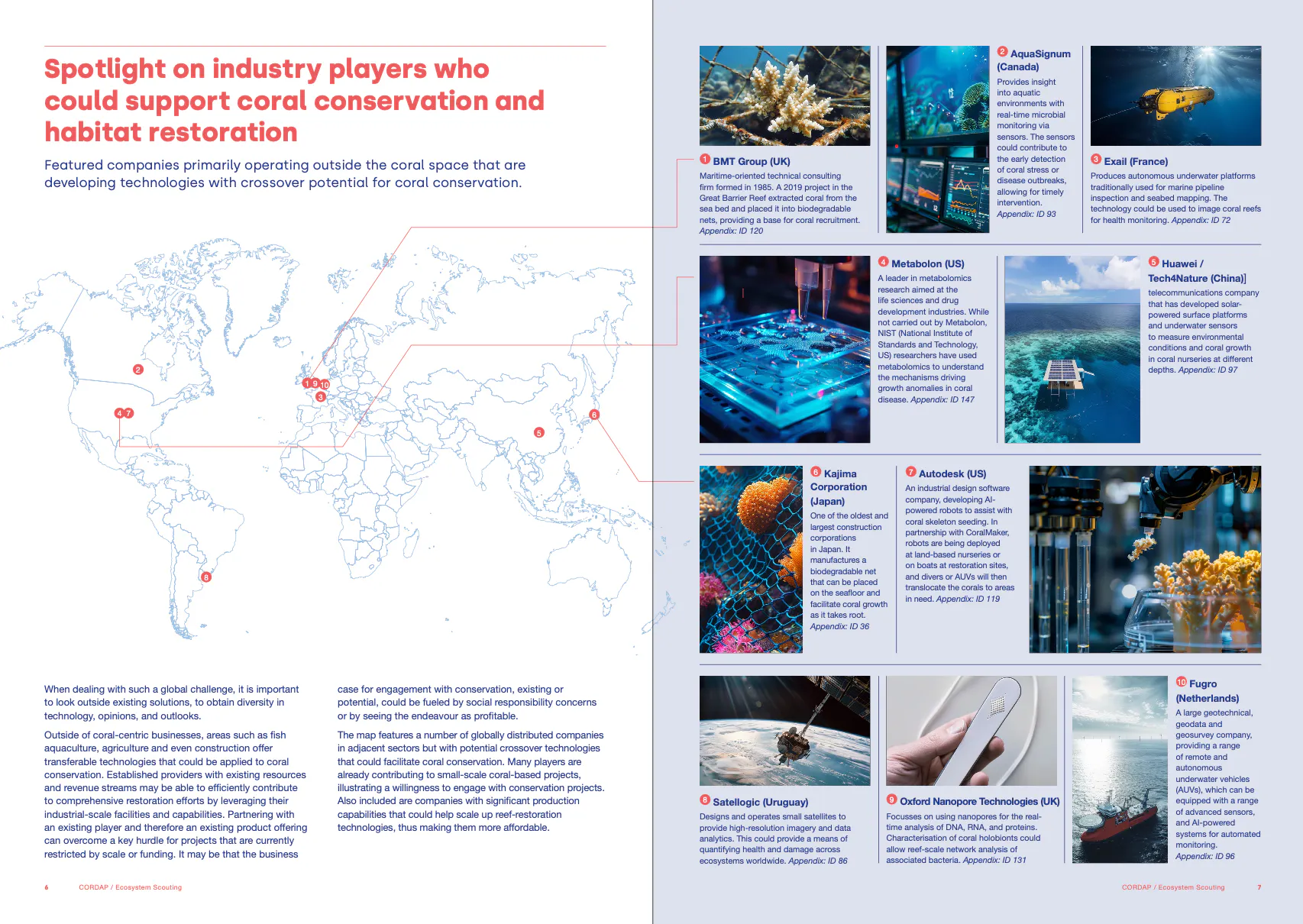
The final output was an immersive, flagship publication, that both told a story for senior-level audiences and provided actionable, technical detail for teams. The document opens with a foreword from CORDAP’s chair, followed by an executive-level overview of the landscape with highlighted companies plotted on a world map. The reader then sees detailed profiles of featured companies, including compelling quotes and insights from our C-level interviews.
The 28-page publication is supported by an appendix listing all 200 companies, and references to supporting information. A cleanly-formatted, easy-to-search database of all 200 companies was provided with the document.
“The report is the first of its kind in the coral restoration field, and a long needed resource for coral restoration practitioners.”
CORDAP
The impact
The ecosystem map provided the deputy director with an actionable dataset and leads for future partnerships. It informed internal funding decisions, while public release of the report on LinkedIn triggered viral engagement with featured companies reposting and tagging collaborators. Beyond charting the technology landscape, the work started a global conversation and gave CORDAP ecosystem-wide visibility to support long-term partnership and scale.