Helping coral restoration find the partners it needs to scale
How Outsmart helped a G20 coral restoration initiative identify industry partners, and understand out what it would take for them to engage to scale up globally.
The Challenge
CORDAP, the G20 Coral Research and Development Accelerator Platform, was established to accelerate the technologies needed to restore the world's coral reefs at scale. While the organisation had successfully funded a growing portfolio of research projects, its leadership recognised that achieving global impact would require stronger engagement with industry.
The ambition was to build partnerships with companies capable of translating promising scientific advances into scalable technologies. However, industry participation had proved difficult to secure. Commercial organisations often struggled to see a compelling business case, while concerns around intellectual property, commercial risk and long-term incentives created barriers to sustained engagement.
Perhaps most importantly, the team suspected that many of the technologies capable of transforming coral restoration already existed in adjacent industries such as biotechnology, aquaculture, environmental engineering and marine informatics, but had no systematic way to identify the organisations with the greatest crossover potential and engage them as long-term partners.
Without this intelligence, CORDAP risked overlooking valuable innovators. If these challenges could be overcome, the organisation could build a stronger innovation ecosystem around coral restoration, creating partnerships to accelerate the transition from promising research to global deployment.
The Solution
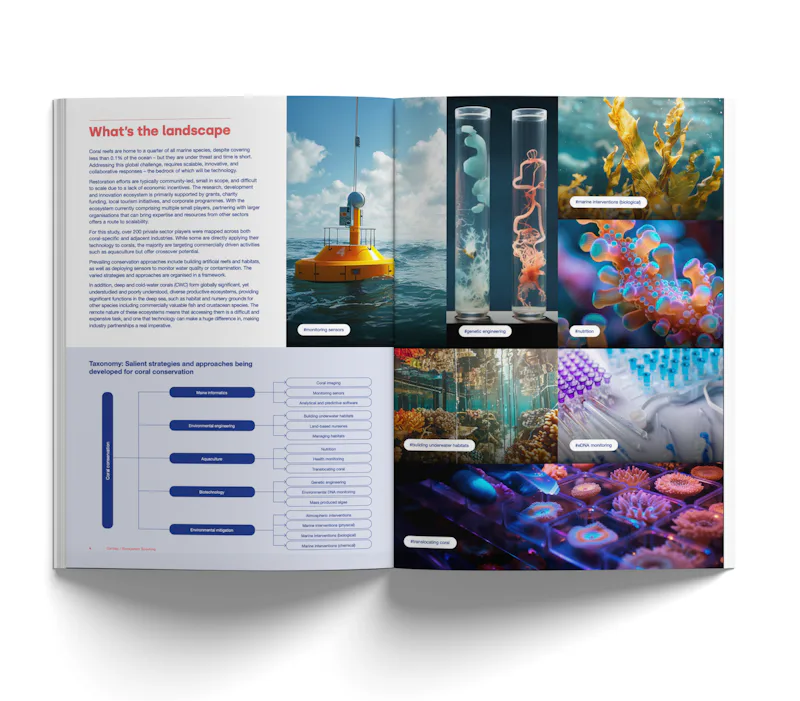
Outsmart built the landscape around a bespoke, technology-driven taxonomy developed specifically for the scientific and engineering challenges of coral restoration. Rather than starting with industry categories, we first mapped the capabilities required to solve the problem: from biotechnology, robotics, sensing and environmental engineering to aquaculture, AI, advanced materials and other adjacent domains. This created a precise framework for identifying not only obvious market players, but also transferable technologies and emerging solutions that conventional sector-based scouting would likely miss.
We then used this taxonomy to assemble a tailored multidisciplinary team from our expert network, matching each taxonomy area with specialists in that domain. As a result, the organisations and technologies were evaluated by the experts best qualified to assess them, not by generalists. Experts covered a wide range of specialisms: from life sciences to marine innovation and industrial manufacturing. This gave CORDAP a deeper, more technically grounded view of the opportunity landscape, revealing where specific capabilities could contribute to coral restoration and where the strongest commercial partnership opportunities lay.
Initial market scanning identified several hundred organisations worldwide. CORDAP and Outsmart then jointly identified the best-fit companies for further investigation based on the input from the specialist assessments. This approach ensured that time and budget were allocated to only the highest-priority opportunities.
Outsmart delivered an ecosystem-wide landscape with detailed technical and commercial partner profiles, giving both visibility and practical engagement intelligence. Targeted interviews with potential partner organisations validated findings, deepened understanding of technical capabilities and commercial intent, and uncovered insights not visible through desk-based research alone.
“The report is the first of its kind in the coral restoration field, and a long needed resource for coral restoration practitioners.”
CORDAP
Technology Highlights:
- Environmental DNA (eDNA) monitoring: Large-volume eDNA sampling systems, combined with quantitative PCR (qPCR) and long-read DNA sequencing, can enable biodiversity monitoring, species detection and DNA metabarcoding. Unlike conventional point sampling, full tidal-cycle sampling generates more representative datasets, allowing species richness, population structure, migration patterns and intervention impacts to be quantified.
- AI-enabled synthetic biology: Machine learning combined with synthetic biology is used to optimise algal strain performance for renewable chemicals and advanced materials production. The study identified opportunities to adapt these approaches for improving biological performance and selecting strains applicable to coral restoration and reef seeding programmes.
- Autonomous underwater monitoring and communications: The landscape included remotely operated underwater vehicles (ROVs), autonomous monitoring platforms and underwater acoustic communication systems inspired by dolphin communication. These technologies support marine research, infrastructure inspection, environmental monitoring, underwater positioning and long-duration autonomous data collection.
- Ocean engineering for environmental restoration: The study identified technologies spanning digitised artificial reefs, autonomous ocean water pumping systems, coastal protection engineering and ocean carbon removal. These combine structural engineering with digital monitoring capabilities to protect coastlines, restore habitats, improve water movement and support long-term marine ecosystem
The Value and Impact
The value extended beyond the original objective. Months later, CORDAP was still using the company database and evaluation framework as the basis for expanding its industry network, discussing how the dataset could evolve into a live, publicly accessible resource that would continue to grow over time.
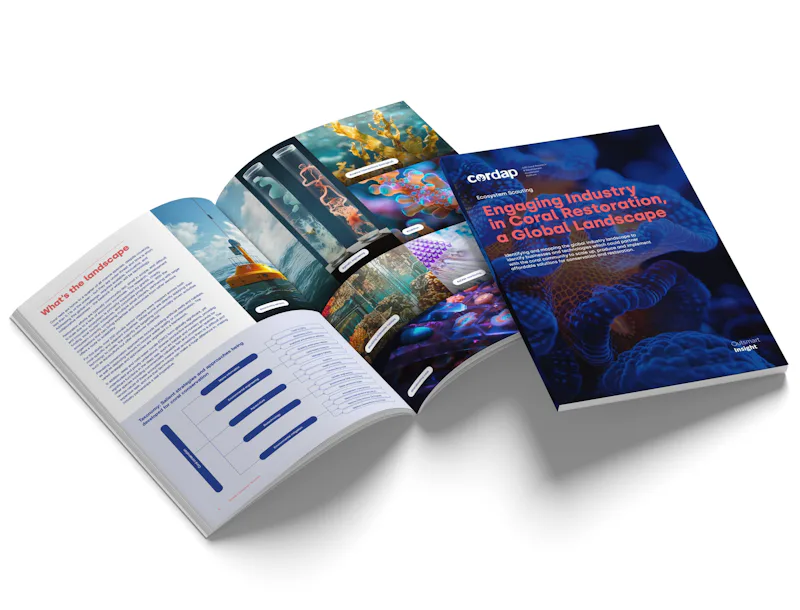
The study also created external engagement. Following publication on CORDAP's website and LinkedIn, additional companies contacted CORDAP requesting to be included, validating the study as a recognised reference point for the emerging coral restoration innovation ecosystem. Internally, the study was recognised as a foundation for future ecosystem development and partnership activity, providing a reusable methodology for identifying commercially relevant partners that can accelerate coral restoration.
The study is publicly available on the CORDAP website and can be viewed here.