The Challenge
Tasked with safely decommissioning Europe’s most expansive and complex nuclear site, Sellafield Ltd operates on timescales few organisations encounter. Its mission extends over a century, with decisions made today influencing operations for decades to come.
From robots to artificial intelligence and from thermal energy storage to distributed sensor networks, technologies capable of transforming its mission are both broad and continually advancing. Across universities, deep tech startups and corporate R&D laboratories, new breakthroughs emerge faster than most organisations can track. For Sellafield’s CTO Office, the challenge was not only identifying frontier technologies, but also developing a systematic way of assessing which innovations were most relevant to their mission, and on which timescales.
To support its long-term mission, the CTO Office had four priorities:
- Strengthen technology horizon scanning capabilities to discover new and unfamiliar technologies that could improve safety and operational performance across the site.
- Inform future R&D investment decisions with evidence-based intelligence on where global science and technology capabilities were heading.
- Build alignment and advocacy among internal stakeholders, regulators, government bodies and funding organisations around future technology priorities.
- Raise Sellafield’s visibility among suppliers developing innovative solutions, helping Sellafield Ltd access the best technologies as new requirements emerge.
The CTO Office also faced several challenges. While specialist teams possessed deep expertise within their own domains, cutting-edge developments emerging elsewhere in the global landscape could be missed. Future technology decisions could not be based solely on existing internal knowledge, so the CTO Office needed a way to systematically uncover new opportunities that were not readily visible to internal teams.
The challenge was compounded by organisational complexity. Multiple programmes, technology teams and stakeholders contributed to long-term planning, making it difficult to establish a shared view of future technology priorities. Increased scrutiny of budgets also required stronger evidence and a practical way to demonstrate the value of future-facing technology initiatives to ensure innovation remained a priority.
The Solution
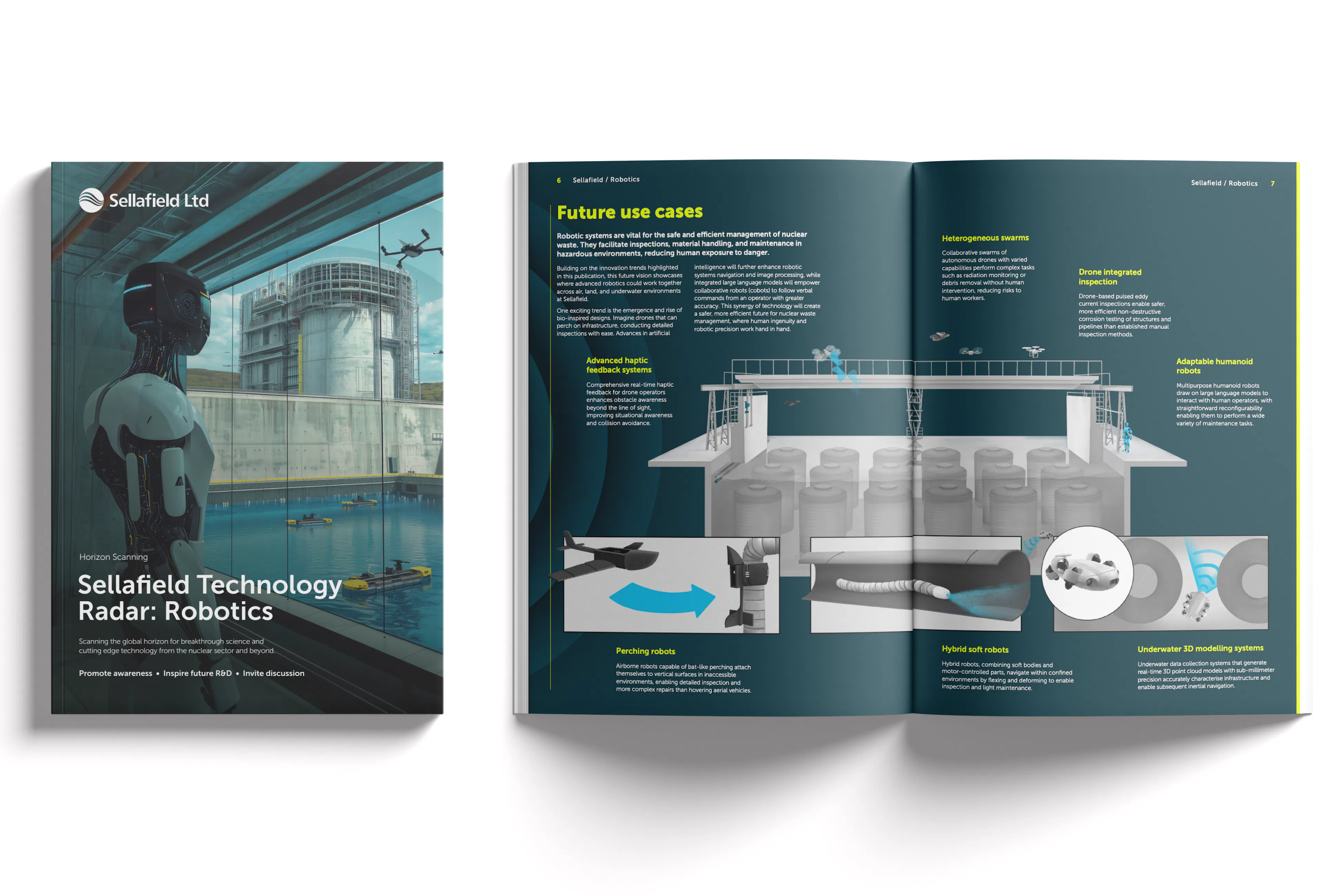
In consultation with delivery-focused teams across Sellafield, the CTO Office prioritised five strategic technology domains for horizon scanning. The rapid growth of artificial intelligence, especially in relation to predictive maintenance and scenario modelling, left stakeholders unsure what was currently or soon to be available. Advances in robotics across air, land and underwater, an established R&D focus at Sellafield, were explored to identify potential development directions. Integrated systems work considered how technologies and data could be connected across Sellafield’s operations. A rising incidence of drone intrusions into critical infrastructure across Europe necessitated a review of Counter-Uncrewed Aerial Systems (C-UAS) technologies, alongside a scan of decarbonisation technologies prompted by updated regulatory requirements.
Outsmart developed dedicated technology taxonomies for each domain. Through a series of workshops and review sessions, our team worked with Sellafield Ltd to define not only the technology areas and challenge themes that should be included, but also those that were out of scope and unlikely to deliver value to the organisation. This ensured the horizon scanning outputs remained tightly aligned to R&D priorities and long-range technology roadmaps.
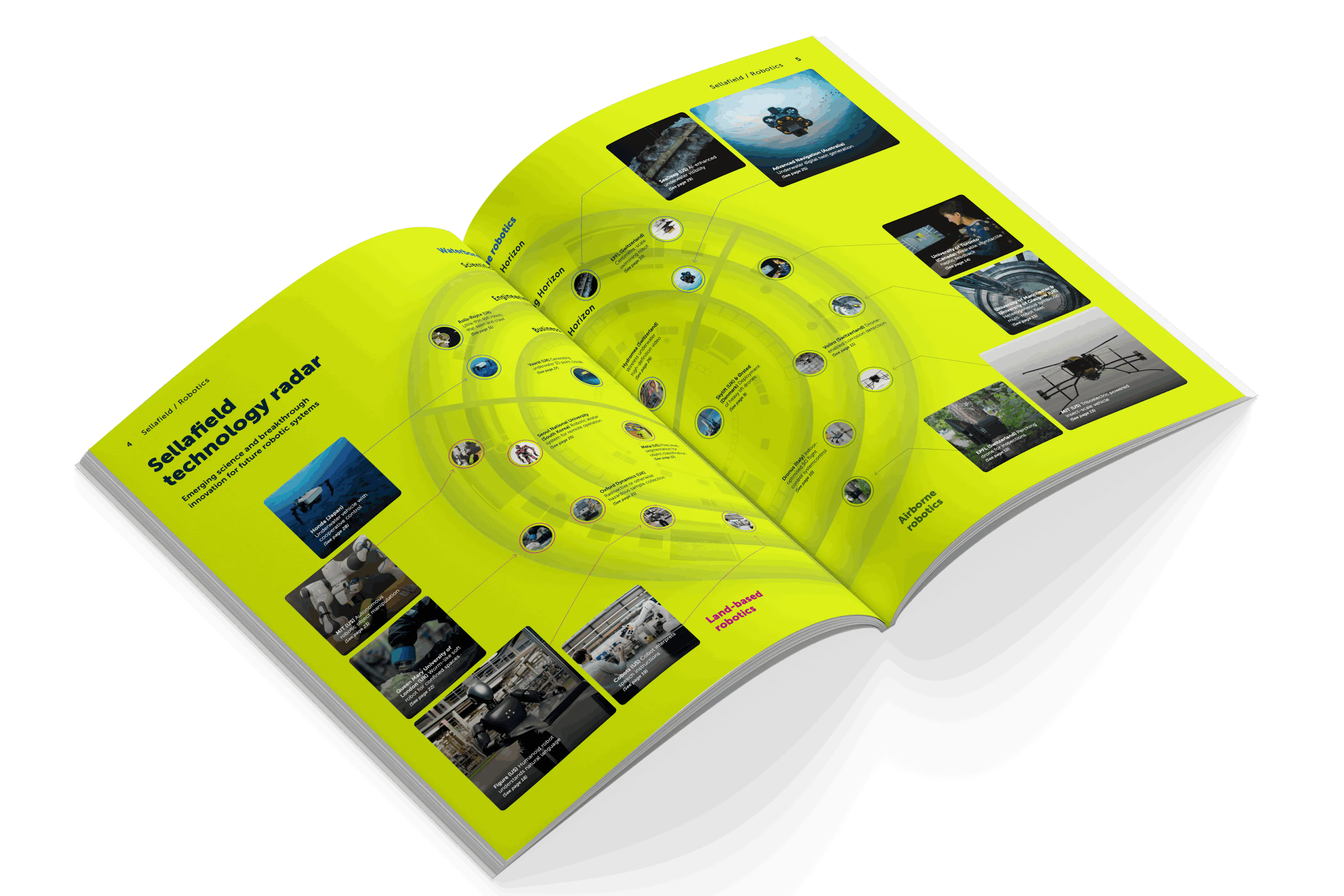
Outsmart applied a Three Horizons methodology to categorise innovations according to maturity, adoption readiness and expected time-to-impact. Experts mapped technologies across the Business Horizon, Engineering Horizon and Scientific Horizon, enabling stakeholders to distinguish between deployable solutions, emerging capabilities and longer-term research opportunities.
Delivery was supported by a multidisciplinary team of analysts, technology researchers and subject-matter experts. For the C-UAS programme alone, Outsmart assembled a team of more than 50 scientists and engineers from universities across the UK alongside industry specialists. This enabled the identification of innovations from both established sectors and emerging research communities.
To complement publicly available intelligence, Outsmart conducted interviews with Sellafield Ltd’s technologists throughout the programme. These discussions helped validate technology relevance, identify future adoption scenarios and provide operational context. Insights were incorporated directly into each publication through expert commentary and challenge-specific use cases.
Technology Highlights
- AI-driven knowledge retention systems (Artificial Intelligence) capture and preserve tacit knowledge from experienced personnel approaching retirement, using multimodal data ingestion, semantic indexing and large language models.
- Micro-Doppler radar classification (C-UAS) promises to distinguish rotating propellers from flapping bird wings by detecting small differences in relative motion.
- Neuromorphic predictive maintenance (Decarbonisation) applies spiking neural network architectures on neuromorphic processors to classify faults such as cavitation and overpressure using vibration data.
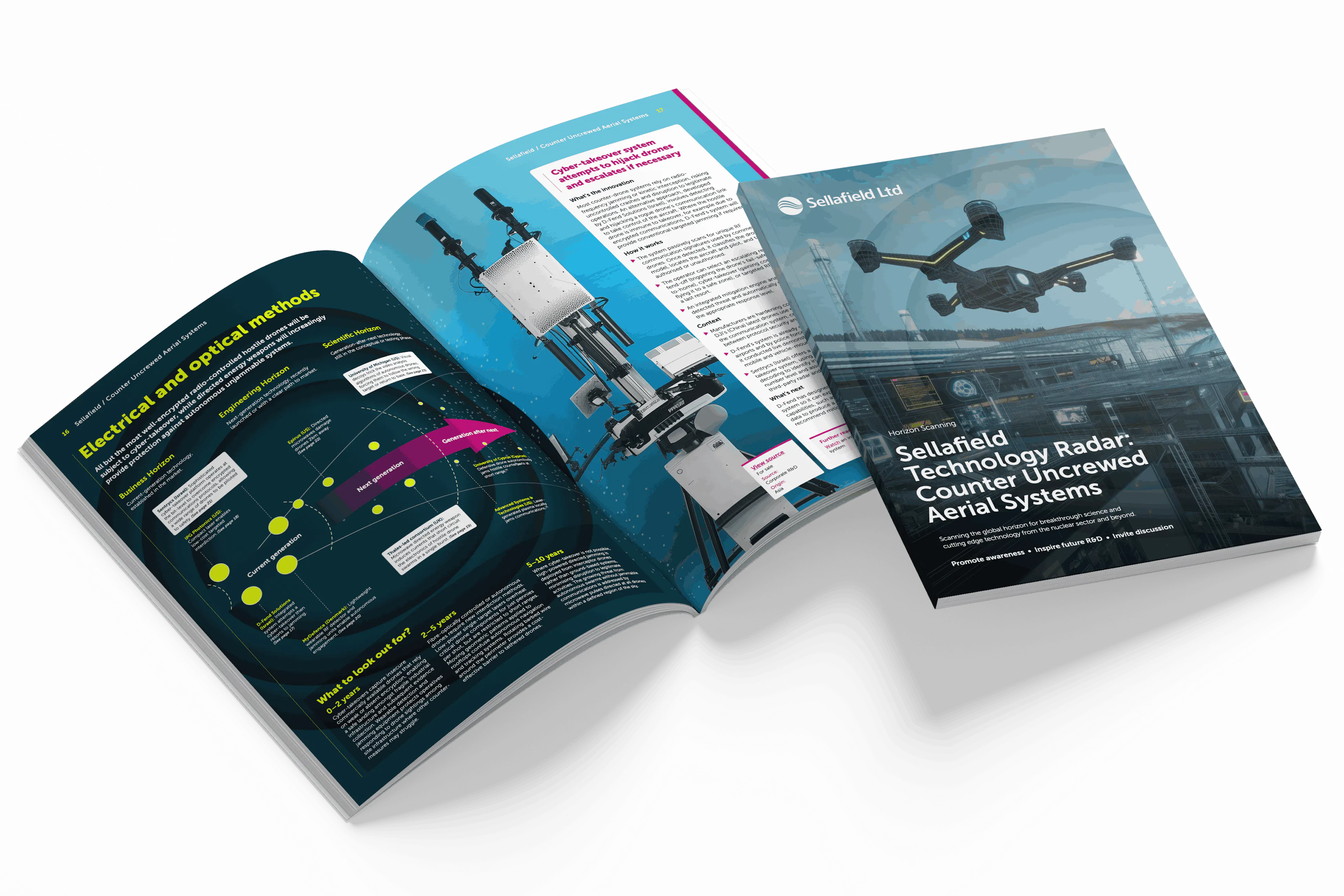
The programme culminated in a series of Technology Radar publications designed to promote awareness, inspire future R&D and stimulate discussion across the organisation. It also included innovation ecosystem mapping and partner identification, providing visibility of organisations developing relevant capabilities across each technology domain.
The Value and Impact
The primary benefit of the programme was improved technology situational awareness and foresight across Artificial Intelligence, C-UAS and Decarbonisation. Through independent horizon scanning, technology assessment and global innovation scouting, the CTO Office gained visibility of state-of-the-art developments, organisations and research activity that may otherwise have remained outside the organisation’s field of view.
The programme also built confidence in the underlying process. Sellafield Ltd valued working with a partner not tied to a specific technology area, sector or supplier ecosystem. This ensured each challenge area could be assessed through a consistent, repeatable and rigorous methodology.
The approach reduced the burden on internal teams. Technology leaders were able to define the challenge area, connect the right stakeholders and trust Outsmart to undertake the research independently.
The Technology Radar series set a high benchmark for future horizon scanning activity. By combining global scouting with a clear editorial framework, the programme helped Sellafield evaluate opportunities, engage potential partners and revisit technology domains as innovation landscapes continued to evolve.